
Korea's high-speed rail changes on September 1, 2026. This guide replaces the old split KTX/SRT booking advice with the official integrated timetable, one Korail platform and a station-first way to choose the right train.
Which Seoul-area station should you search?
| Option | Seoul Station | Suseo | Best for |
|---|---|---|---|
| Location | Central Seoul, west of the city center | Southeast Seoul, in Gangnam-gu | Choose by your hotel and morning transfer |
| From September 1 | KTX, KTX-Sancheon and selected KTX-Cheongryong departures | KTX and KTX-Sancheon departures | Compare both in Korail+ when either terminal is practical |
| Fastest listed example | 2 hr 18 min | 2 hr 11 min | A fast train is useful only if reaching its station is easy |
Times are examples from the official timetable effective September 1, 2026. Operating dates and stops differ by train, so use the live Korail+ result as the final authority.
The Seoul to Busan train is now one integrated KTX journey to book in Korail+.
What changes for the Seoul to Busan train on September 1, 2026?
One high-speed network and one booking platform
The important change is not simply a new app icon. Korail begins integrated high-speed rail operation on September 1, 2026, combining the former KTX and SRT operating systems. Korail says the rolling stock is operated as one KTX fleet and that trains previously branded SRT become KTX-Sancheon. For a traveler, the practical result is a single search that can show departures from Seoul Station and Suseo instead of forcing a choice between two companies before the timetable is visible.
SR's passenger notice draws a firm date line. SRT tickets are sold only for trains operating through August 31. For a journey on or after September 1, including a departure from Suseo, use the integrated Korail+ app, the Korail website or a station ticket counter. The existing KorailTalk app can be updated to Korail+, while a fresh installation is also available. Advice that still tells a September traveler to buy a separate SRT ticket is out of date.
Membership is useful but should not become a barrier to planning. SR's integration Q&A says a traveler can still buy as a non-member, while converting to an integrated account is necessary to carry over eligible SR history, coupons and member benefits. If you had an SR account, complete the conversion before a busy booking day. If you only need a normal ticket, first make sure you are searching the correct date, origin station and passenger count.
Should you leave from Seoul Station or Suseo?
Choose the terminal before you choose the fastest train
Seoul Station is the natural starting point for hotels around Myeongdong, City Hall, Jongno, Hongdae and much of central or western Seoul. It is a major rail and subway hub, but the building is large and the approaches can be busy. Add time to find the correct concourse, check the departure board and walk to the platform. Our first-time Seoul guide helps place the station within a wider arrival plan.
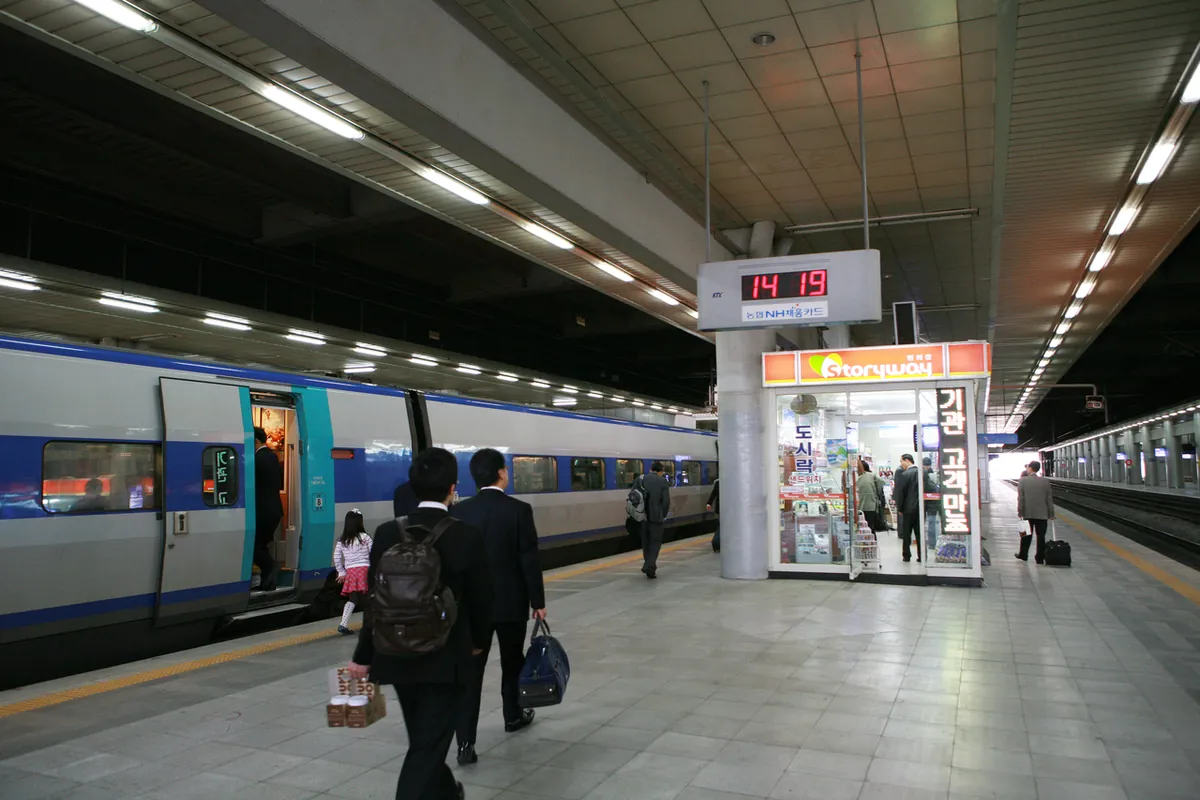
Suseo is in southeast Seoul and can be more convenient from parts of Gangnam, Songpa or the southern metropolitan area. From September 1 its Busan-bound services appear as KTX or KTX-Sancheon in the same Korail+ search. Do not assume that a Seoul Station ticket lets you board at Suseo, or the reverse. SR explicitly warns that the two terminals are not treated as interchangeable same-city stations for route-specific products such as commuter passes. A normal reserved ticket should always show the station where you will actually board.
Gwangmyeong can be worth checking if you are already in southwest Seoul or nearby Gyeonggi, but it is outside central Seoul and requires its own transfer plan. A departure that is ten minutes faster on the railway can still create a longer door-to-door trip if the origin is awkward. Compare hotel-to-platform time, not only the scheduled train duration. The payment and local-transit setup in our Korea transport cards guide is useful for the first and last urban legs.
How long does the Seoul to Busan KTX take?
The official KTX timetable effective September 1 lists the fastest Seoul Station–Busan journeys at 2 hours 18 minutes. Many direct services take roughly 2 hours 30 minutes to 2 hours 50 minutes, and some patterns exceed three hours. From Suseo, the fastest listed Busan trip is 2 hours 11 minutes, with many other departures around 2 hours 24 minutes to 2 hours 48 minutes. These are scheduled examples, not a promise for every day or train.
Why is the range so wide? Direct means that you stay on one train, not that the train runs nonstop. A faster service may call at only a small set of major stations, while another adds Cheonan-Asan, Osong, Gimcheon(Gumi), Gyeongju or Ulsan. Some Seoul departures use the Suwon route, and selected trains approach Busan through Miryang or Gupo. Those patterns can be useful for a particular passenger, but they are slower for someone traveling all the way to Busan Station.
The timetable includes KTX, KTX-Sancheon and selected KTX-Cheongryong services. Do not choose purely by train name: compare the exact departure, arrival and stop list displayed for your date. Operating-day notes differ, so a train shown on a weekend may not run on a weekday. We recommend saving the booked departure in your calendar and checking Korail+ again the evening before travel for any operational notice.
Which stations can a Seoul–Busan KTX stop at?
On the main Gyeongbu high-speed corridor, a Seoul Station train can serve Gwangmyeong, Cheonan-Asan, Osong, Daejeon, Gimcheon(Gumi), Seodaegu, Dongdaegu, Gyeongju and Ulsan before Busan. A Suseo-origin train can also serve Dongtan and PyeongtaekJije. The official timetable additionally shows variants involving Yeongdeungpo, Suwon, Gyeongsan, Miryang, Mulgeum and Gupo. No individual train stops at every station in this list.
For a Busan city trip, make sure the destination is Busan, not Gupo or Bujeon. Gupo is within Busan but sits west of the principal tourist areas and appears only on selected routing patterns. Bujeon is a different station used by other rail services. Busan Station is the straightforward arrival for Nampo, the old port and Metro Line 1 connections. If your hotel is in Haeundae, the urban transfer continues after the KTX, so allow that extra journey in the day's plan.
How much is the KTX ticket from Seoul to Busan?
Korail's official integration announcement publishes a Seoul–Busan KTX fare of KRW 54,400 from September 1, 2026. Use that as the current reference for an ordinary one-way ticket on the principal route, then read the amount attached to your exact result. A premium seat, a different routing, an eligible promotional fare or another origin such as Suseo can produce a different total. The checkout screen is the final price for the selected passenger and service.
This is an area where old travel pages can cause real mistakes. Do not build a budget from a pre-integration KTX table or a separate SRT fare. The official change aligns the integrated KTX fares from September 1, and the Seoul–Busan figure above comes from Korail's August announcement. If your travel date is August 31 or earlier, the old split system still applies; if it is September 1 or later, use the integrated result.
Discount inventory and eligibility can be narrower than ordinary tickets, so do not assume that every departure will show the same deal. Compare a few practical times, but value a usable station and arrival hour over a small saving. If your payment does not complete online, do not treat a reservation screen as a ticket. Check the booking record or buy at an official station counter, and keep the final ticket accessible without relying on a fragile browser tab.
How do you book the train in Korail+?
A station-first booking sequence
Open Korail+ or the Korail website and set the operating date first. Enter Seoul or Suseo as the origin and Busan as the destination, add the correct number and type of passengers, then search. Compare arrival time and duration as well as departure time. Open the stop list before choosing a service, especially when two trains leave within a few minutes of each other but one takes much longer.
Confirm that the travel date is September 1, 2026 or later before applying the integrated-booking advice.
Search Seoul Station and Suseo separately if both are realistic from your accommodation.
Check the destination says Busan and review the listed operating day, duration and intermediate stops.
Select the intended seat class and read the final fare before completing payment.
Verify that the ticket appears in your booking record, then save the train number, car and seat details offline.
Tickets for trains operating from September 1 first opened on August 5 at 10:00 KST as part of the integration rollout. That launch date is historical context, not a reusable rule for every future journey. For your own date, use the live calendar in Korail+ rather than assuming a fixed release interval from an older guide. Popular Friday evenings, Sundays and holiday periods can sell out earlier than an ordinary midweek departure.
Arrive with enough time to navigate the station without sprinting. Twenty to thirty minutes is a practical buffer for a first visit when you already hold a ticket; add more if you must collect help, manage large luggage or find the station from an unfamiliar subway exit. Korean high-speed trains are identified by number and departure time. Match both on the board, then confirm the car-position markers on the platform before the train arrives.
What should you expect on the journey?
A reserved KTX ticket assigns a train, car and seat. Keep bags controlled and use the available rack or space without blocking the aisle or doors. Storage layouts differ by train type, so a very large suitcase is easier to manage when you board early and avoid the busiest departure. Keep medicine, passport, wallet and electronics with you rather than in a bag placed out of sight.
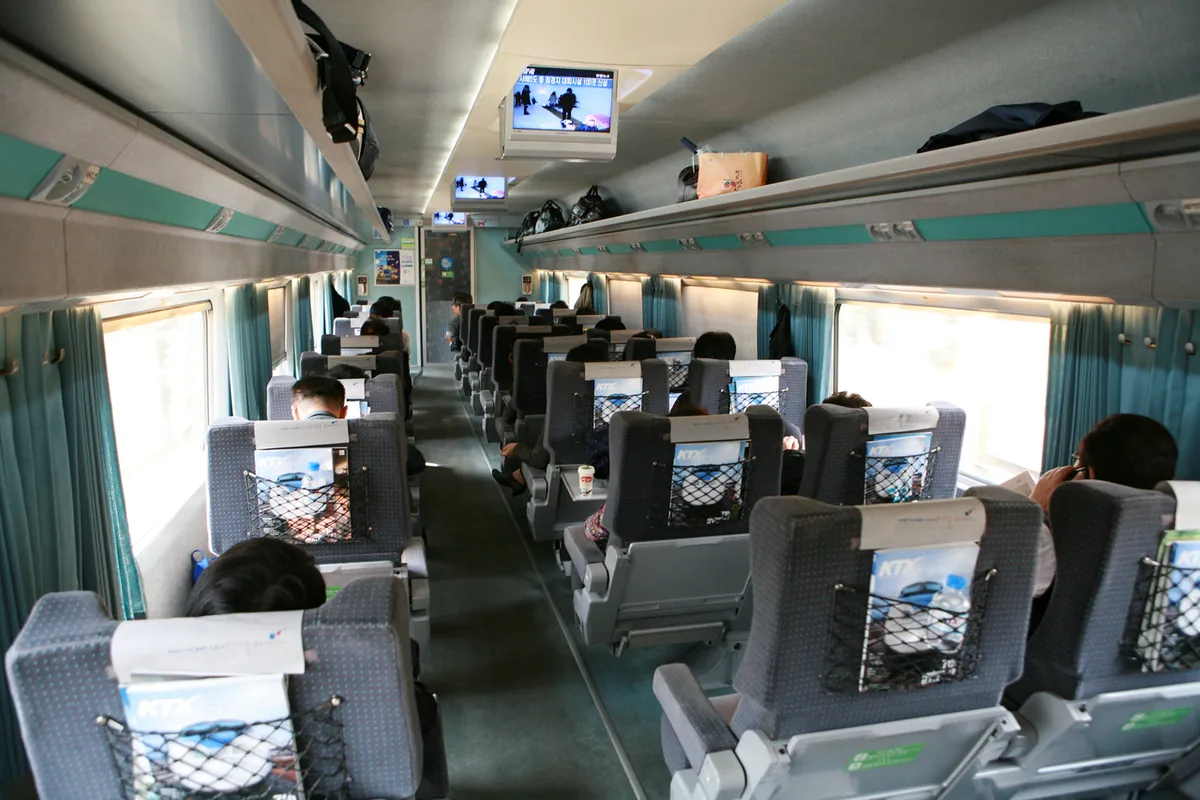
Mobile data helps with platform changes and the Busan transfer. Set it up before the station rather than during boarding; our Korea eSIM guide explains the main choices. Bring water and a simple snack if needed, but keep the table and neighboring seat clear. Station and onboard retail availability can change, so do not make a tight meal plan depend on a particular shop or trolley.
The route is comfortable enough to use as travel time rather than a lost day. A fast train can place you in Busan before lunch, while a later departure preserves a final Seoul morning. Still, do not schedule a timed attraction immediately after arrival. A small delay, the walk through Busan Station and the onward subway or taxi leg can consume the margin. Build the first Busan reservation around a realistic hotel check-in and local transfer.
What happens when you arrive at Busan Station?
Busan Station is a large central terminal facing the port side of the city. Follow signs into the main concourse before deciding between Metro, bus or taxi. Nampo and the old downtown are relatively close, while Seomyeon is a useful interchange and Haeundae lies much farther east. Keep the station name in Korean available for a driver, and use live routing for the final connection rather than an article's fixed bus number.
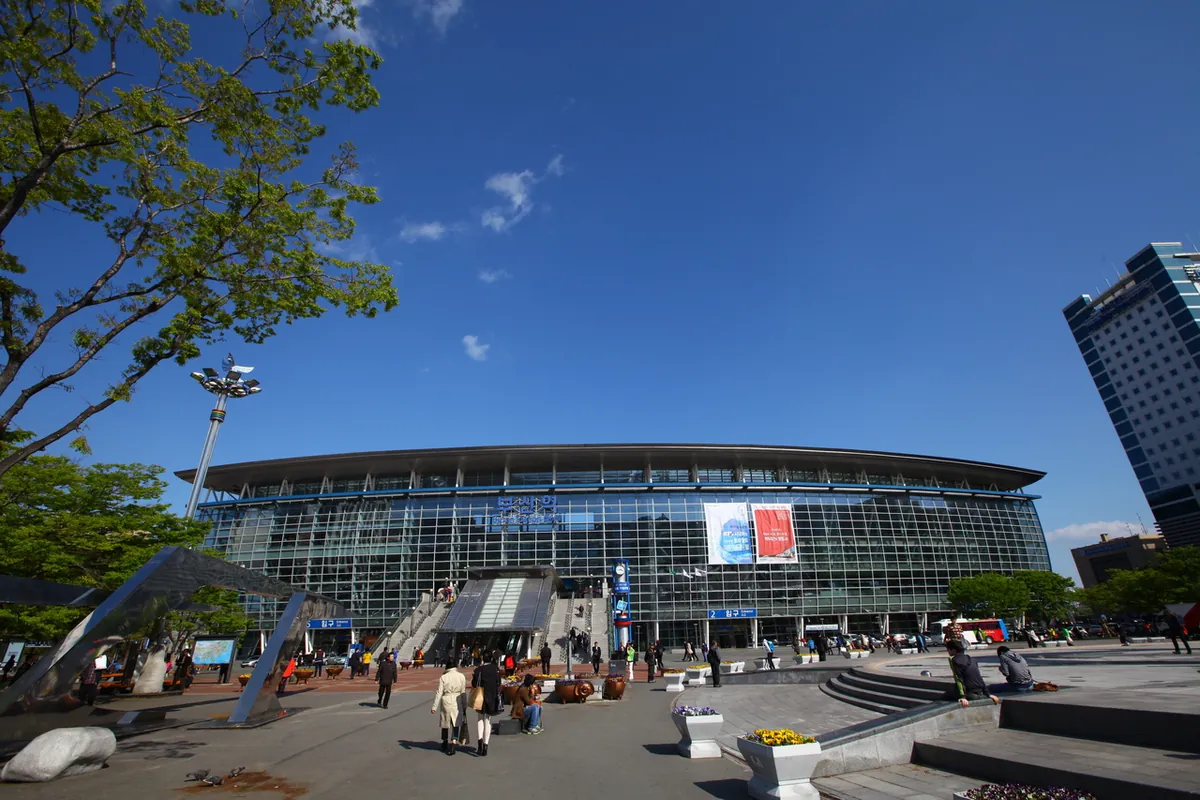
If you are staying near Haeundae or Gwangalli, the KTX is only the intercity part of the journey. Protect another hour or more for the urban transfer depending on the destination and traffic. Travelers with a short stay should group Busan by geography; our three-day Busan itinerary keeps the old port, eastern beaches and Yeongdo on separate days instead of crossing the city repeatedly.
Store luggage or check in before beginning a hillside or coastal route. Gamcheon, Huinnyeoul and the beach districts are poor places to drag a suitcase through stairs or crowds. If the coastal rail is part of the trip, reserve it as its own east-Busan block and use our Busan Sky Capsule guide to choose a direction and return plan. The KTX arrival time should support the itinerary, not force every attraction into the same afternoon.
Is Busan realistic as a day trip from Seoul?
It is possible, but the arithmetic is less attractive than the fastest train time suggests. A round trip includes two station transfers, pre-departure buffers and roughly five hours or more aboard the trains. A focused day around Nampo, Jagalchi and one nearby district can work with an early departure and a confirmed evening return. Haeundae plus the western markets creates too much cross-city movement for a relaxed day.
One night is the better minimum when the city itself matters. Two or three nights let you see both the old port and eastern beaches without treating Busan as a photograph between trains. If a day trip is unavoidable, buy the return ticket at the same time, choose one geographic anchor and identify what you will drop if the morning runs late. Do not rely on purchasing the final useful train after sightseeing during a busy weekend.
Which mistakes cause the most trouble?
Using a separate SRT booking guide for a train that operates on or after September 1, 2026.
Buying from Suseo when the hotel transfer makes Seoul Station much easier, or making the opposite mistake from Gangnam.
Comparing only departure times and overlooking a stop pattern that adds forty minutes or more.
Selecting Gupo or another Busan-area station without checking the onward route to the hotel.
Treating a payment attempt or screenshot as a confirmed ticket without checking the booking record.
Booking an attraction too soon after arrival and leaving no margin for the local transfer.
The simplest reliable plan is also the most current: search the integrated Korail platform, choose the origin that fits your location, read the exact stop list and protect the first hour after arrival. That method remains useful even when individual departure times change. It also avoids the biggest 2026 error—following an old division between KTX at Seoul Station and SRT at Suseo after the system has moved to one KTX network.
Last verified: August 30, 2026. We checked the integration rules against Korail and SR notices and calculated journey examples from the official KTX timetable effective September 1, 2026. Reconfirm your exact train, fare, operating day and station in Korail+ before travel.
Frequently Asked Questions
Do I still need the SRT app for a Suseo to Busan train?
Not for a train operating on or after September 1, 2026. SR says those Suseo departures are purchased as KTX through Korail+, the Korail website or an official station counter.
How long is the KTX from Seoul Station to Busan?
The official timetable effective September 1 lists the fastest Seoul Station trip at 2 hours 18 minutes. Many direct trains take about 2 hours 30 minutes to 2 hours 50 minutes, while slower stopping patterns exceed three hours.
How much is the Seoul to Busan KTX ticket after integration?
Korail publishes a KRW 54,400 Seoul–Busan KTX fare from September 1, 2026. Check the final Korail+ price because seat class, discount eligibility, routing and origin station can change the amount.
Is Seoul Station or Suseo better for Busan?
Seoul Station generally suits central and western Seoul, while Suseo can be easier from Gangnam, Songpa and the southeast. Compare the hotel-to-platform journey before choosing the faster scheduled train.
Last verified: August 2026 · TipsKorea Editorial


